\(QS5_{3}^{(0)}\)
Description
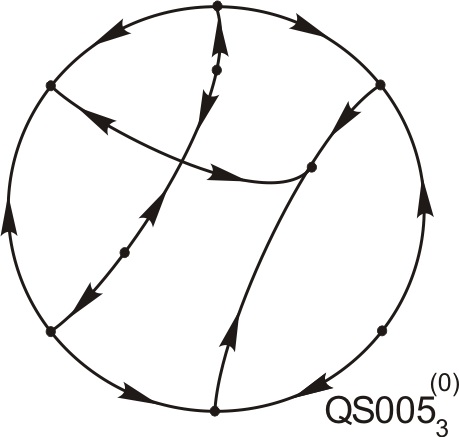
Phase Portrait
Topological Invariants
| TCSP | Fin Sep | Inf Sep |
|---|---|---|
| \(5\) | \(4322\) | \(111110\) |
Example
The quadratic differential system
\[\begin{cases} \dot{x} = -100 \, x \, (1-x+6 \, y)+e \, y \\ \dot{y} = y \, (1+5 \, x/2-y) \end{cases}\]
with parameters: \(e = 2\)
has the following phase portrait done with P4. If you want, you may download the P4 file here.
The phase portrait appears in the following papers
- With names \(Chap 3 9\) and \(Chap 3 16\) in {B. Imane and B. Souad}, Global phase portraits of quadratic differential systems exhibiting an invariant algebraic curve or an algebraic cubic first integral, {Ph.D. Universite Mohamed el Bachir}, (2020).
- With names \(4\), \(16\), \(18\) and \(24\) in {R. Benterki and J. Llibre}, Phase portraits of quadratic polynomial differential systems having as solution some classical planar algebraic curves of degree 4, Electron. J. Differential Equations { bf 2019}, Paper No. 15, 25 pp.; MR3919655
- With name \(116\) in {B. Coll, A. Ferragut and J. Llibre}, Phase portraits of the quadratic systems with a polynomial inverse integrating factor, Internat. J. Bifur. Chaos Appl. Sci. Engrg. { bf 19} (2009), no.~3, 765--783; MR2533481
- With name \(4.3c\) in {D. Schlomiuk and N. Vulpe}, Integrals and phase portraits of planar quadratic differential systems with invariant lines of total multiplicity four, emph{Bul. Acad. c{S}tiin c{t}e Repub. Mold. Mat.}, { bf 1 (56)} (2008), 27--83.Note (for name \(4.3c\)): missed arrow, wrong width
- With names \(4,3c\) and \(3,1(b3)\) in {D. Schlomiuk and N. Vulpe}, Global classification of the planar Lotka--Volterra differential systems according to their configurations of invariant straight lines, emph{J. Fixed Point Theory Appl.}, { bf 8}, no. 1 (2010), 177--245.
- With name \(5\) in {A. Ferragut, J. D. García-Saldaña and C. Valls}, Phase portraits of Abel quadratic differential systems of second kind with symmetries, Dyn. Syst. { bf 34} (2019), no.~2, 301--333; MR3941199Note (for name \(5\)): The angles on the saddle are weird
- With names \(Fig1.f\) and \(Fig2.a\) in {J. Llibre and C. Valls}, Global dynamics of a system coming from the study of a static star, Differ. Equ. Dyn. Syst. { bf 32} (2024), no.~2, 607--617; MR4721747
- With name \(PP11\) in {J. Llibre and H. X. Ou}, Quadratic systems with two invariant real straight lines and an invariant parabola, Electron. J. Qual. Theory Differ. Equ. { bf 2025}, Paper No. 66, 54 pp.; MR5018064
- With names \(Fig. 38 h\), \(Fig. 39 g\) and \(Fig. 40 a\) in {J. Llibre and C. Pantazi}, Global phase portraits of the quadratic systems having a singular and irreducible invariant curve of degree 3. Internat. J. Bifur. Chaos Appl. Sci. Engrg. 33 (2023), no. 1, Paper No. 2350003, 54 pp.
- With name \(Fig. 5 e3.1\) in Missing reference in Tavares
- With name \(S^2_{12,3}\) in {J. C. Artés, R. E. Kooij and J. Llibre}, Structurally stable quadratic vector fields, Mem. Amer. Math. Soc. { bf 134} (1998), no.~639, viii+108 pp.; MR1432139
- With name \(Portrait 28\) in {J. C. Artés, J. Llibre and N. Vulpe}, Quadratic systems with an integrable saddle: A complete classification in the coefficient space $ mathbb{R^{12}$}, emph{Nonlinear Anal.}, textbf{75}, no. 14 (2012), 5416--5447.
- With names \(Fig 2B I\), \(Fig 2B II\), \(Fig 2B V\), \(Fig 2B XIII\), \(Fig 2C I\), \(Fig 2C III\), \(Fig 2C VII\), \(Fig 2D I\), \(Fig 2D II\) and \(Fig 2D V\) in {J. W. Reyn}, Phase portraits of a quadratic system of differential equations occurring frequently in applications, emph{Nieuw Arch. Wisk. (4)}, textbf{5}, no. 2 (1987), 107--151.
Neighbours of Codimension 1
- Through the border \(QS7_{3}^{(1)}\), by means of a bifurcation of type \(B\), we reach the neighbor \(QS3_{1}^{(0)}\).
- Through the border \(QS74_{6}^{(1)}\), by means of a bifurcation of type \(C\), we reach the neighbor \(QS10_{5}^{(0)}\).
- Through the border \(QS74_{5}^{(1)}\), by means of a bifurcation of type \(C\), we reach the neighbor \(QS10_{16}^{(0)}\).
- Through the border \(QS31_{7}^{(1)}\), by means of a bifurcation of type \(A\), we reach the neighbor \(QS19_{1}^{(0)}\).
- Through the border \(QS31_{6}^{(1)}\), by means of a bifurcation of type \(A\), we reach the neighbor \(QS19_{3}^{(0)}\).
- Through the border \(QS5_{6}^{(1)}\), by means of a bifurcation of type \(D(c)\), we reach the neighbor \(QS5_{2}^{(0)}\).
- Through the border \(QS5_{4}^{(1)}\), by means of a bifurcation of type \(D(c)\), we reach the neighbor \(QS5_{6}^{(0)}\).